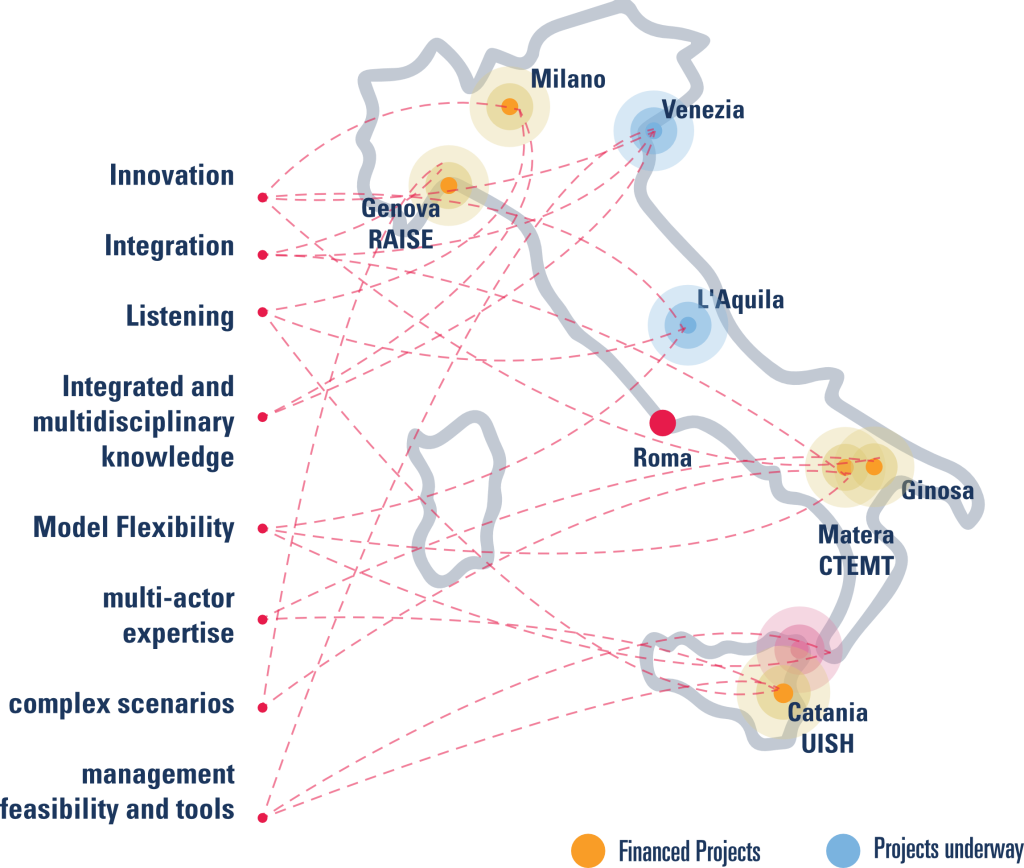
C.I.S.C. network
Universities:
University of L’Aquila
The collaboration focuses on the digitalization and monitoring of the built environment, with the aim of improving the quality, safety, and sustainability of cities. Activities include the development of digital models for the assessment and management of the built environment through the analysis of various scenarios and decision support for both ordinary and emergency situations..
University of Basilicata
Collaboration launched for the development of the Digital Twin of Water, a dynamic model for monitoring and simulating the behavior of urban water networks. The agreement involves joint data collection, modeling, and predictive analysis to support evidence-based decisions in water management.
University of Catania
Collaboration within the UISH project for the development of digital models dedicated to urban planning, urban mobility, and the environmental quality of Catania’s historic center. The university provides technical and scientific support, laboratories, and specialized expertise for data collection, simulation, and result validation.
University of Perugia
Local Authorities:
Municipality of Catania
Collaboration within the UISH project for the development of digital models for the city of Catania. The agreement includes modeling and scenario development for the digital twin.
Municipality of Ginosa (TA)
Trial of the Urban Digital Twin to support decisions and policies regarding mobility and urban well-being. The project involves traffic flow analysis, simulation model development, and the involvement of schools to promote safe routes and sustainable mobility. The goal is to improve the quality of life in the city through simulations capable of understanding and interpreting the city’s evolution.
Municipality of Matera
The development of Matera’s Urban Digital Twin, within the House of Emerging Technologies, is part of the strategic Urban Intelligence project, aimed at integrating urban planning and advanced digital technologies. The GDU allows for the representation and simulation of the city’s evolution, supporting decisions on urban transformation, heritage protection, and sustainable land management. The goal is to provide operational tools for data-driven urban policies geared towards quality of life.
Municipality of Milan
The networking activity included the presentation of the Guidelines to Metropolitan Cities, starting in Milan on September 21, 2023, with the presentation of the Urban Digital Twin as an urban governance tool. This was followed by several meetings and scientific exchanges (October 5, 2023, October 10, 2023, January 11, 2024), which led to the development of initiatives supporting the 2026 Milan-Cortina Paralympics.
The Roadshow:
Metropolitan City of Cagliari
Metropolitan City of Bari
On July 13, 2023, at the Municipality of Bari, the UI Model Guidelines were presented by Eugenio Di Sciascio, Councilor for Urban Regeneration. The topics that emerged were mobility and built heritage.
Metropolitan City of Messina
The third meeting was held in Messina on September 28, 2023, with Councilors Camminiti and Cicala, discussing the issue of territorial control in terms of urban security. The topics of interest for the Digital Gems were air quality and how to use the geoportal in a model like UISH for aspects related to heritage recovery, energy savings, and soil pollution.
Metropolitan City of Naples
The second meeting was held in Naples on September 21, 2023, with Francesca Pignataro as the coordinator. The meeting discussed the Urbani twins’ perspectives on sustainable mobility (PAES), the energy plan, how to integrate the GIS with intelligent and participatory platforms, and the importance of exploring water networks and climate models to analyze their impact on neighborhoods. A second meeting on November 21, 2023, explored the construction of underground water systems and pedestrian flows.
Metropolitan City of Reggio Calabria
The fourth meeting in Reggio Calabria on June 29, 2023, with Dr. Stracuzza, included a comprehensive presentation of the guidelines and the identification of various topics of interest. Further meetings followed, focusing on the creation of collaborative working groups with local authorities to systematize mobility data to support and guide the development of sustainable and accessible routes. Collaboration options were explored on the issues of urban proximity and smart neighborhood regeneration based on the UISH model.