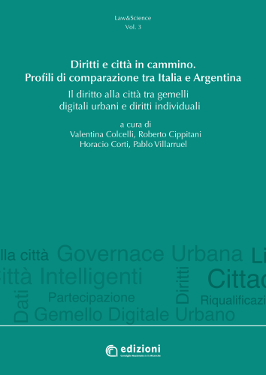
Presentation of the book at the CNR Central Library: "Rights and Cities on the Move. Comparative Profiles between Italy and Argentina. The Right to the City between Urban Digital Twins and Individual Rights"
edited by Valentina Colcelli, Roberto Cippitani, Horacio Corti, Pablo Villarruel (CNR Editions, “Law&Science” Series, No. 3)
The book addresses the theme of the “right to the city” by comparing the Italian experience in applying Urban Intelligence through urban digital twins with the urban governance of Buenos Aires. Through legal analyses, case studies, and interviews with stakeholders, it investigates how digital technologies and participatory processes can support urban planning and management, active citizenship, and the improvement of quality of life, while highlighting regulatory risks and policy scenarios to ensure inclusive and responsible urban rights.
The volume was developed within the framework of the Emerging Technologies House of Matera (CTEMT) and the PON-POC UNISH Urban Intelligence Science Hub for City Network projects. The book can be downloaded from the CNR Editions catalog web page and at the following link:
For further information:
https://www.cnr.it/it/new_editoriali
Volume realizzato nell’ambito dei progetti Casa delle Tecnologie Emergenti di Matera (CTEMT). PON-POC UNISH Urban Intelligence Science Hub for City Network
ROMe – 15/10/2025
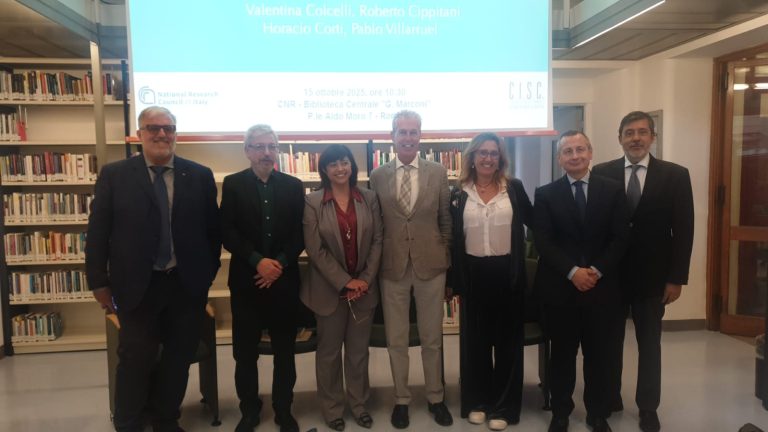
The National Research Council (CNR) hosted the presentation of the book “Rights and Cities on the Move, the Right to the City between Digital Twins and Individual Rights,” which explores the right to the city by comparing Italian and Argentine experiences. Following institutional greetings by CNR Director Dr. Nicola Fantini and Department Director Prof. Emilio Campana, the discussion was introduced by Dr. Giordana Castelli, Coordinator of the CISC (Interdepartmental Center for City Sciences), and Dr. Valentina Colcelli (CNR-IFAC).
The book offers a multidisciplinary and multilocal reflection on new forms of urban governance. In Italy, digital twins are revolutionizing the relationship between citizens and cities through technology. In Argentina, the right to the city serves as a key tool to guarantee inclusion and equal dignity in popular communities. The text also traces the rich cultural and legal history of the right to the city from ancient civilizations to the present day, citing figures such as Luigi Sturzo and Giorgio La Pira, who emphasized the municipal dimension as the cornerstone of rights and coexistence. The role of digitalization in cities is highlighted, with its opportunities and challenges regarding privacy, security, and data protection. A central theme is the creation of networks between cities based on accessible, shared open-source technologies to promote common goals and participatory governance. The intercultural and interdisciplinary dialogue among Italian, Argentine, and Spanish experts has enriched the understanding of the right to the city in a global context.
Highlights and main contributions:
● Dr. Giordana Castelli, Coordinator of CISC CNR, and Dr. Valentina Colcelli (CNR-IFAC) introduced the theme of the right to the city and its legal and social implications.
● Prof. Horacio Corti, professor at Universidad de Buenos Aires and member of the Consejo de la Magistratura Argentina, presented the Argentine experience in urban governance.
● Researcher Maurizio Gentilini (CNR-ISEM) outlined the historical and cultural framework of the right to the city.
● Prof. Roberto Cippitani, from Universidad Nacional de Educación a Distancia in Madrid, explored the opportunities offered by digitalization to safeguard urban rights.
● The discussion was moderated by Pierangelo Giovanetti, Spokesperson of the National Anti-Corruption Authority.
The book is a significant contribution to the debate on how technology and social justice can come together to make cities fairer, more inclusive, and participatory, placing citizens’ fundamental rights at the center of urban and digital policies.


